
You’ll attach your pergola to your house by first checking for gutter interference and marking post positions 84 inches from the wall.
Dig footings 18–36 inches below the frost line, set posts in concrete, and wait 24 hours before loading.
Attach the ledger board directly to house framing with ½-inch lag screws and neoprene washers, then seal all connections with metal flashing and exterior sealant.
Install beams with epoxy-filled threaded rods, caulk joints, and plan annual inspections to prevent moisture damage.
Getting these details right now prevents costly repairs later.
Pergola Structural Requirements: Foundation Depth and Load Capacity
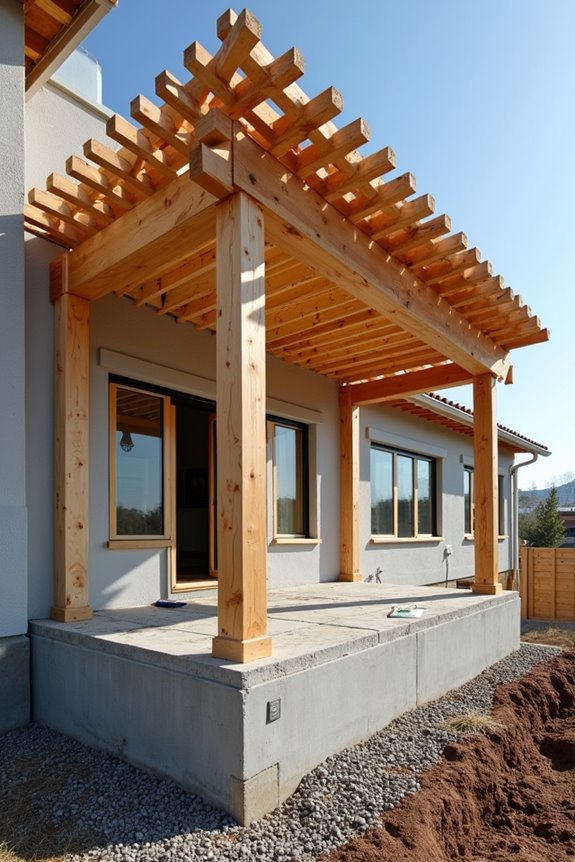
Deeper footings distribute weight more effectively. Posts require minimum 24-inch concrete embedment for stable pergola foundations.
Some pergolas remain stable for decades while others develop movement after a few seasons. The difference comes down to your foundation. You need concrete footings extending 18–36 inches below your area’s frost line. This depth prevents frost heave from shifting your posts.
Your foundation depth directly affects load capacity. Deeper footings distribute weight more effectively. Posts require minimum 24-inch concrete embedment. Laminated posts resist twisting during curing.
Post anchoring demands precision. You’ll use epoxy-filled 5/8-inch through-bolts or threaded rod for secure connections. This structural hardware ensures even weight distribution.
Let concrete cure 24 hours before loading. Rushing this step compromises everything. Most pergola failures happen at the foundation stage because people skip these critical steps. Getting this right prevents costly failures.
Check for Gutters, Downspouts, and Roof Interference
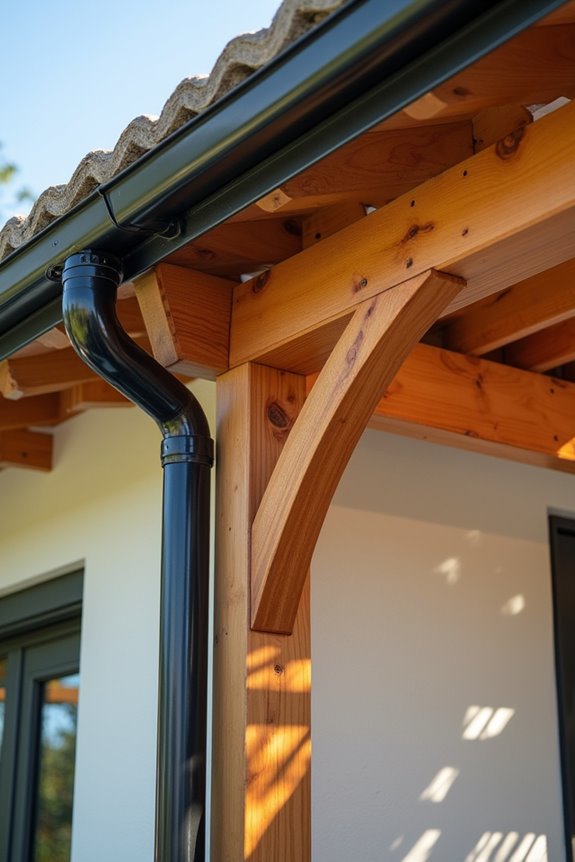
Before you attach anything to your house’s fascia board, you’ll need to deal with your gutters and downspouts. These drainage systems can interfere with your pergola installation. Check what gutter style you have—K-style, half-round, or square—since each requires different handling approaches.
You’ll likely need to detach gutter sections where posts attach to the fascia. This temporary removal prevents damage and allows proper installation. Use appropriate brackets or spacers to keep gutters away from your new structure once reinstalled.
Plan your downspout routes carefully. Redirect them so water flows away from your pergola’s foundation and the house. Poor water drainage causes foundation problems and structural damage over time.
After installation finishes, reattach all gutters securely. Inspect hangers and spikes for stability. Clear any debris from gutters to maintain proper water flow around your new pergola.
Materials, Tools, and Hardware Checklist
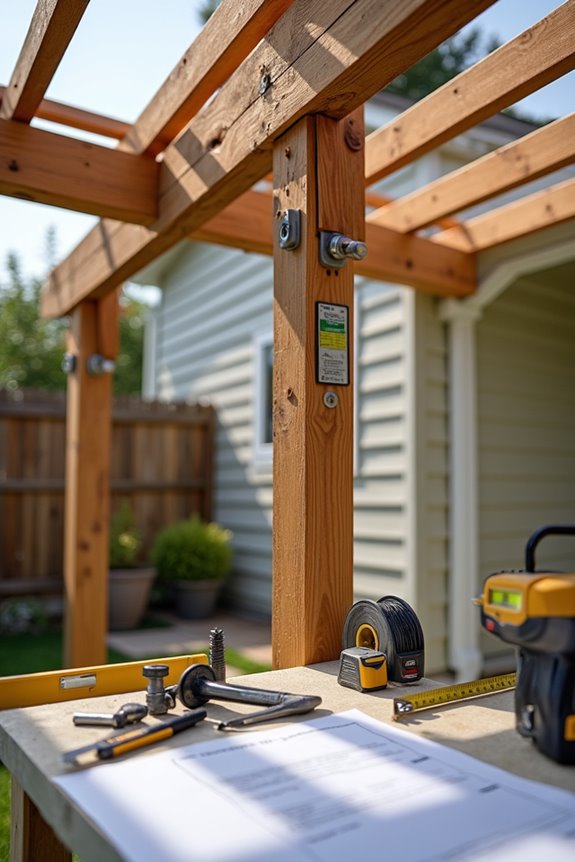
Before you start attaching that pergola, you’ll need to gather the right materials, tools, and hardware—no shortcuts here. We’re talking about everything from lag screws and neoprene washers to masonry anchors and epoxy, plus the specific tools you’ll use to install them safely and securely. Getting this checklist right upfront saves you frustration, extra trips to the hardware store, and potential structural problems down the road.
Essential Materials Overview
What separates a pergola that lasts decades from one that fails in a few years? Your materials choice. You’ll need quality components that work together consistently.
Start with a sturdy ledger board. This attaches directly to your house and carries the pergola’s weight. Heavy-duty fasteners like carriage bolts and lag screws keep everything secure. Pre-drill ½-inch pilot holes to prevent wood splitting.
Protection matters too. Install flashing and a moisture barrier between the ledger and siding. These prevent water damage that destroys wood from inside out.
Essential materials you’ll gather:
- Pressure-treated lumber for ground contact
- Post bases to elevate wood away from moisture
- Stainless steel fasteners resisting corrosion
- Neoprene washers protecting screw heads
- End grain sealant protecting exposed wood
This foundation keeps your pergola beautiful and structurally sound for years ahead.
Required Tools Selection
| Tool | Purpose |
|---|---|
| Power Drill | Drilling pilot holes and epoxy connections |
| Impact Driver | Driving lag screws and structural connections |
| ½-inch Drill Bit | Creating pilot holes for ledger boards |
You’ll need a power drill with a 5/8-inch drill bit for epoxy connections. An impact driver handles lag screws efficiently without stripping them. A tape measure ensures accuracy for post placement and spacing. You should also have a level to keep everything straight.
A helper makes working at heights safer. Don’t skip the safety gear: hard hat, gloves, safety glasses, and steel-toe boots. These tools and precautions make a challenging project manageable work.
Hardware Specifications Guide
Getting the right hardware matters more than you’d think. You’ll need specific materials to connect your pergola securely to your house and posts. The right choices prevent costly mistakes down the road.
Here’s what you’ll gather:
- Lag screws (1/2 inch diameter, 4 inches long) for ledger board attachment
- Threaded rod cut to beam width plus 5 inches for post connections
- Two-part epoxy for every beam-to-post joint
- 5/8-inch drill bit for boring through beams into posts
- Pilot holes (1/2 inch) where lag screws meet framing
You’ll drill 5 inches into posts. Then you’ll fill those holes with epoxy and insert threaded rod completely. Allow 12 hours minimum curing time before loading your pergola. Blow out sawdust beforehand. Getting these specs right keeps your pergola secure for years.
Mark Post Positions on Level Ground
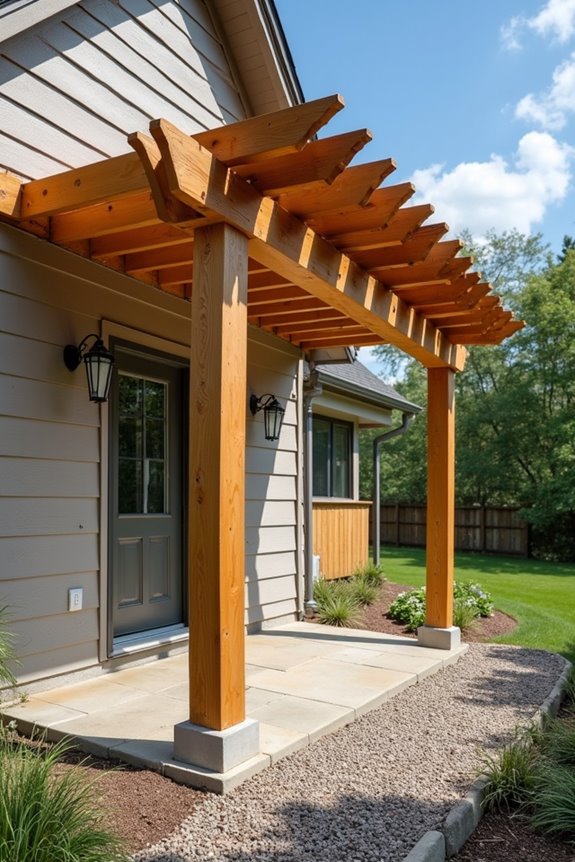
You’ll start by measuring 84 inches from your house wall to mark where your first post goes. Run a string line 4 inches away from the wall to keep your posts parallel, then measure 2.5 inches from that string line to find your post’s center point—this alignment matters because it positions your beam connection exactly where you need it.
String Line Reference Setup
How do you align your pergola posts parallel to your house? Use a string line reference system. This method provides reliable alignment for your entire project.
Start by measuring 84 inches from your house wall. Position your string line exactly 4 inches away from the wall. This creates your reference baseline.
Here’s what you’re setting up:
- Measure 84 inches outward from house wall
- Place string line 4 inches from wall surface
- Determine post centers 2.5 inches from string line
- Check alignment across the entire span
- Mark diagonal corner-to-corner lines on each post site
Your string line reference keeps everything square and parallel. Transfer these precise center marks for drilling and setting. Consistent spacing produces professional results and sturdy installation.
Post Center Alignment Verification
Where exactly do your post holes go? That’s where post alignment becomes important. You’ll measure 84 inches along your reference line to mark each post center. This spacing keeps your pergola structurally sound.
Now verify those centers are parallel. Check that each post maintains equal offset from your reference line. Use string lines to cross-check perpendicular alignment to your ledger. This prevents skew that would compromise the structure.
Find your center point transfer by drawing diagonal corner-to-corner lines on the ground. Where they intersect? That’s your exact post center. Mark it clearly.
Before footing placement happens, verify everything’s level and square. Transfer ground marks to your post-base area with precision. Recheck after adding temporary bracing. Getting these details right means your final pergola stands plumb and true.
Dig and Set Posts Below the Frost Line
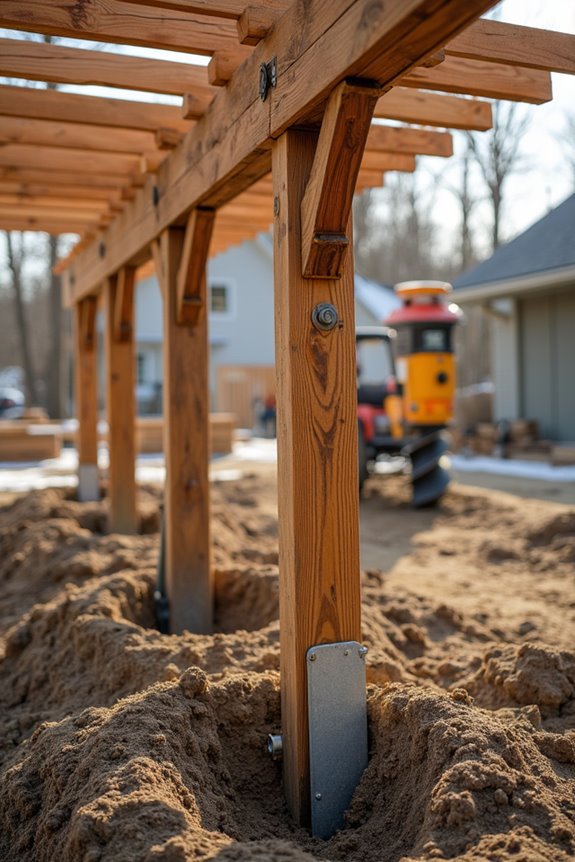
Why does digging deep matter so much? Frost heave destroys pergolas. When frozen ground expands and contracts, it shifts your posts upward. You’ll prevent this problem by digging below the frost line.
Your post depth determines everything. Dig 18–36 inches deep in most areas. Frost-prone zones require 36–42 inches. Use a three-times-post-diameter width for your hole.
Your setup strategy:
- Measure frost line depth for your region first
- Dig holes wider than post diameter by three times
- Position post bases or footings to elevate posts above ground
- Keep posts one-third above-ground before backfilling
- Brace posts temporarily during concrete curing
Set concrete with proper alignment and bracing. Wait 24 hours for full curing before loading your pergola. This patience prevents future settling and structural problems.
Attach the Ledger Board to House Framing
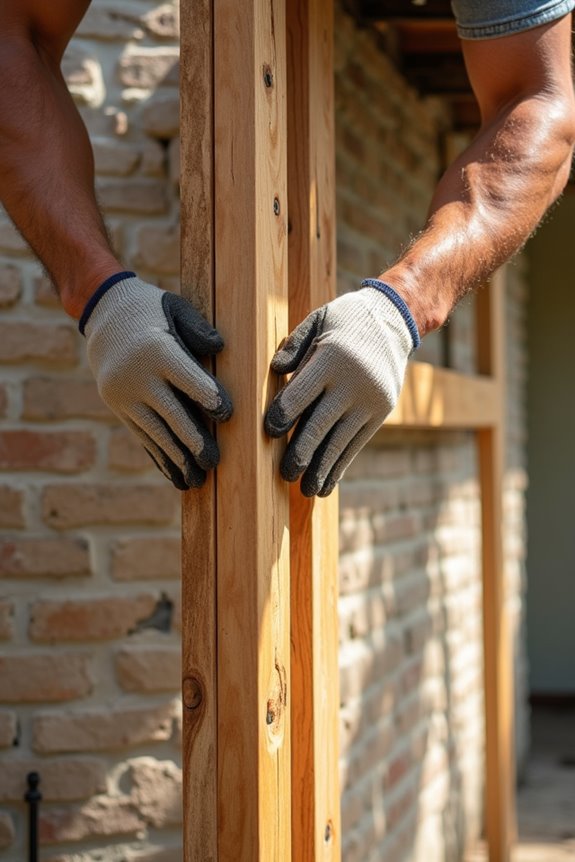
Your pergola’s connection to the house is critical. You’ll attach the ledger board directly to your house framing using ½-inch lag screws driven into studs with neoprene washers. These washers prevent water damage and maintain a watertight seal.
Start by marking your ledger location accurately. Measure 105 inches below the deck surface for proper alignment. Use ¾-inch-thick shims that are 1¾ inches wide beneath the ledger board. Apply sealant to all cut surfaces immediately to prevent moisture intrusion.
Install metal flashing between the ledger and siding. This water management step stops wall moisture problems before they start. You’ll need helper assistance to maintain level alignment while fastening. Verify horizontal plumb before final tightening. Plan your gutter placement so downspouts won’t obstruct the pergola later.
Prepare and Mark the Beam
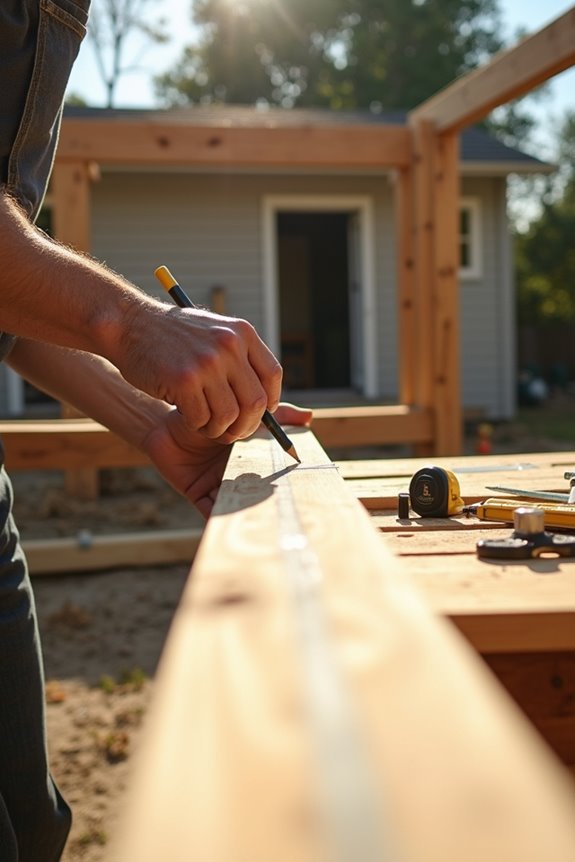
You’ll now measure your beam and mark where everything connects. Start by establishing your beam’s layout line, accounting for that 1:12 slope and 7.5-inch drop across your 225-inch length. Then transfer your post-center marks from the beam’s side face to its top face, squaring them perpendicular to the edge so you know exactly where to drill.
Measure and Layout
Your beam preparation depends on precision. You’ll mark post centers by tracing from your marked post locations onto the beam’s top face. Square these marks perpendicular to the edge for alignment with your ledger during assembly.
Your layout tasks include:
- Setting notch locations and depths on your 225-inch beam
- Establishing a 1:12 slope for proper water drainage
- Creating ½-inch pilot holes at marked positions
- Squaring post center marks across the beam width
- Planning epoxy application points before drilling
Next comes the drilling phase. You’ll use a 5/8-inch drill bit with an extension to bore through the beam and five inches into each post. This depth provides solid connections. Clean away all sawdust with compressed air before applying epoxy. Your layout precision determines your installation success.
Mark Attachment Points
How precise do your beam markings need to be? Extremely precise. You’re creating permanent attachment points between your pergola and ledger. Start by positioning the beam on your posts. Mark the post center directly onto the beam’s side. Transfer that center line to the beam’s top face. Square it perpendicular to the edge using a carpenter’s square.
Next, establish your rafter notch locations along the beam’s length. This planning prevents drilling errors later. You’ll use a 5/8-inch drill bit with extension to penetrate through the beam and five inches into each post. Drill pilot holes at ½-inch diameter where rafters will attach. These holes prepare the surface for fasteners and epoxy.
Remove all sawdust thoroughly before drilling. Clean surfaces provide stronger bonds and more reliable connections.
Cut Posts to Height
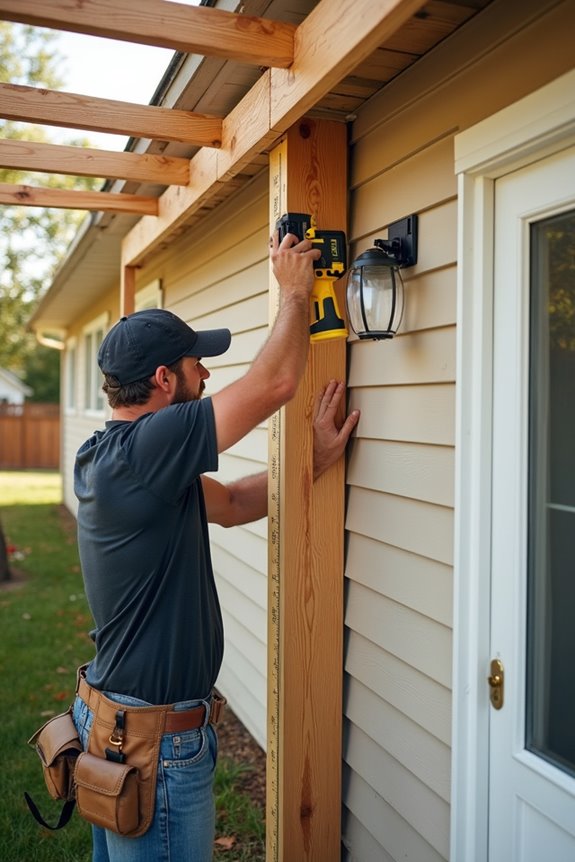
Now that your posts are secured in place, they need to be cut to the exact height where your beam will sit. This step determines your pergola’s success.
Cutting posts to exact height is critical—this step determines your entire pergola’s structural success.
Calculate your post height by measuring 7½ inches down from level. Then add 2½ inches for beam thickness. Mark this line on each post using a chalk line for accuracy.
What to do:
- Measure twice. Cut once. Mistakes cost time.
- Use a circular saw for clean, straight cuts.
- Sand all cut edges immediately after cutting.
- Apply wood sealant to protect against moisture.
- Verify each post height matches the others.
Your beam alignment depends on consistent post height. Beveling the tops is optional but improves water drainage. Make sure notches align with your ledger for a square connection. When all posts are cut correctly, your level beam will sit perfectly across them.
Connect the Beam Securely to Posts Using Epoxy and Threaded Rod
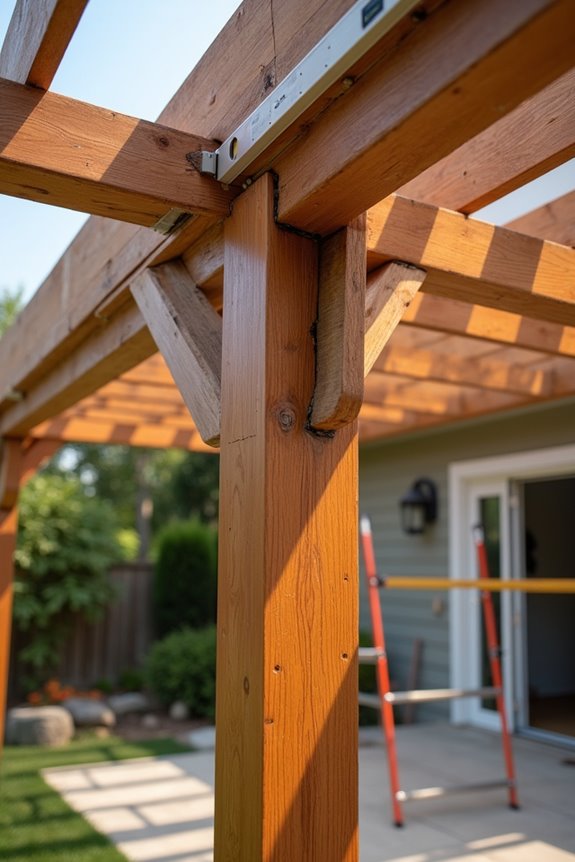
You’ll need to mark and position your posts with precision before drilling. Start by aligning the beam on the posts and marking the post center onto the beam’s side, then use a perpendicular square to transfer that center line to the beam’s top face. This epoxy-and-threaded-rod connection requires careful preparation and patience during the curing process.
Marking And Positioning Posts
What’s the secret to a rock-solid beam-to-post connection? Proper marking and positioning. You’ll start by placing your beam directly on the posts. Then mark the post center onto the beam’s side. Transfer that mark to the beam’s top face. Square it to the edge for accuracy.
Finding the post center requires a simple technique:
- Draw diagonal lines from corner to corner on the beam
- Mark where the diagonals intersect
- This intersection point is your post center
- Use this spot for drilling alignment
- Double-check measurements before proceeding
This post positioning step determines your entire epoxy-rod connection success. Accurate beam alignment prevents wobbling and structural weakness. You’re establishing the foundation for a secure ledger/attachment that will last decades. Take your time here—rushing causes frustration later.
Epoxy Installation And Curing
With your posts marked and positioned correctly, you’re ready for the strongest part of this connection. Drill a 5/8-inch hole through the beam and 5 inches into the post using an extension bit for proper alignment. Fill the drilled hole completely with epoxy from bottom up before inserting the threaded rod. This ensures full epoxy distribution and creates a durable structural bonding.
Cut your threaded rod to length equal to the beam width plus 5 inches. Insert it into the epoxy-filled hole and twist to distribute the epoxy evenly throughout.
Position the beam on your posts and clamp firmly. Allow the beam-post connection to cure overnight for a minimum of 12 hours. This curing time is necessary.
After curing, remove all dust and debris. Cut rod ends as needed. Verify your connection remains plumb and square before proceeding.
Install Rafters at the Correct Spacing
How do you keep rafters from looking haphazard or creating structural weak spots? You’ll follow your spacing plan consistently. Rafters space at 38 inches on center. This consistent rafter spacing prevents weak points and keeps your pergola looking professional.
Consistent 38-inch rafter spacing prevents weak points and maintains a professional, polished pergola appearance throughout.
Your spacing plan matters:
- Place outermost notches first to anchor the entire layout
- Cut notches 13/16 inch from center on each rafter
- Pre-drill 1/2-inch pilot holes for alignment before installation
- Secure with two 6-inch structural screws through the beam face
- Drive three-inch deck screws through the rafter into the ledger with minimum two screws per connection
Test each rafter for snug, wobble-free fit at both ends and the middle before final installation. This methodical approach keeps your pergola structurally sound while maintaining a polished appearance throughout.
Add Purlins for Even Shade and Load Distribution
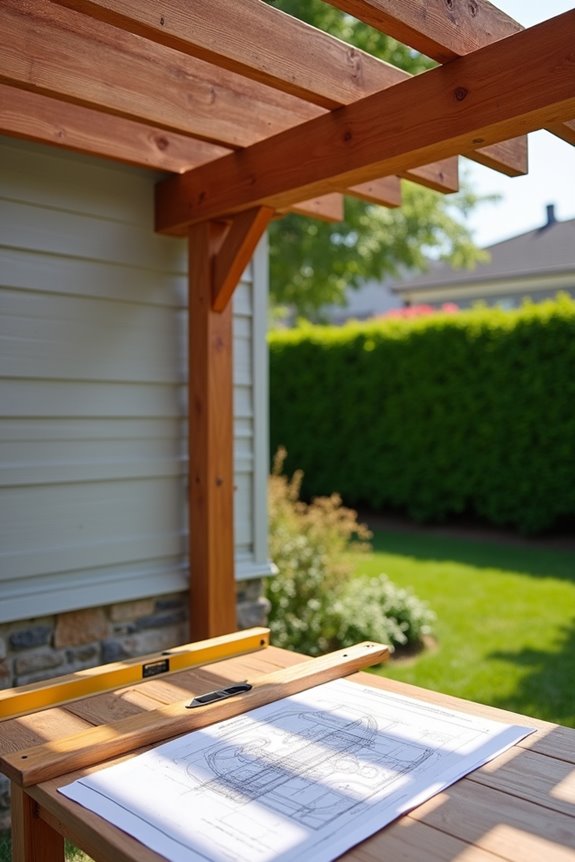
After your rafters are securely fastened, you’ll add purlins—the horizontal pieces that run perpendicular to your rafters. These strengthen your structure. You’ll install four purlins by dividing your pergola’s depth into three equal segments. Position one purlin at each end. Place two more in the middle section.
Snap chalk lines across all rafters at your spacing marks. This maintains straight alignment. Straighten any bowing using body weight or clamps before fastening.
Attach each purlin with two 3-inch deck screws per rafter connection. Angle screws slightly to grip better and prevent wood splitting. This attachment technique distributes loads evenly across your entire beam and ledger system.
Proper purlin alignment maintains structural stability and supports long-term durability.
Seal Ledger Connections and Wood Surfaces Against Water Damage
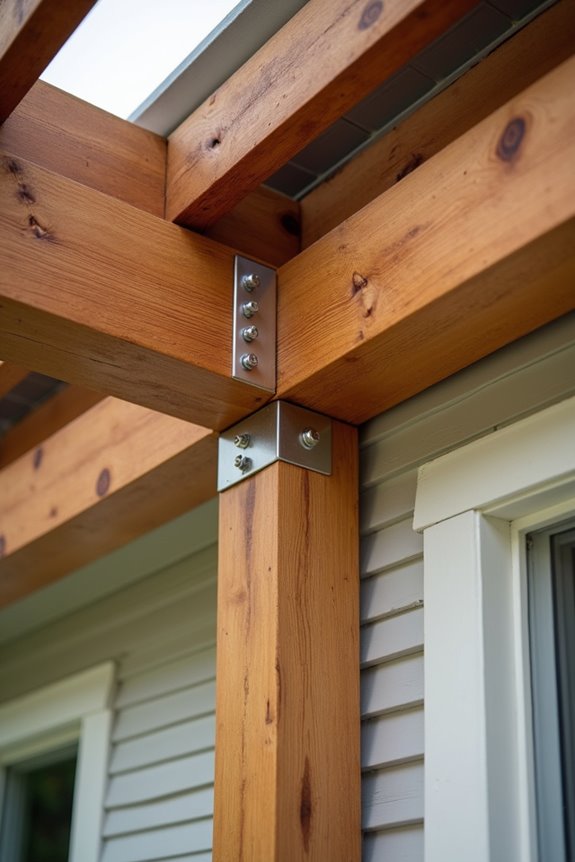
Water is your pergola’s biggest enemy. The ledger connection where your structure attaches to your house needs serious protection. Without proper sealant and flashing, moisture sneaks in and causes rot that spreads fast.
Water is your pergola’s biggest enemy—protect that ledger connection with proper sealant and flashing to prevent rot.
Here’s what you’ll do to protect your investment:
- Seal all end grain on posts and beams before installation starts
- Install continuous flashing between the ledger and your house siding
- Caulk top joints where posts meet beams with exterior-grade sealant
- Apply weatherproof finishes to exposed wood surfaces
- Recoat sealants every 1–3 years depending on your climate
That ledger-to-wall interface deserves your attention most. Use waterproof silicone rated for exterior use. This moisture protection prevents wall damage inside your home too. You’re not just protecting wood—you’re protecting your house’s foundation from hidden water problems.
Safety Gear and Best Practices Before You Build
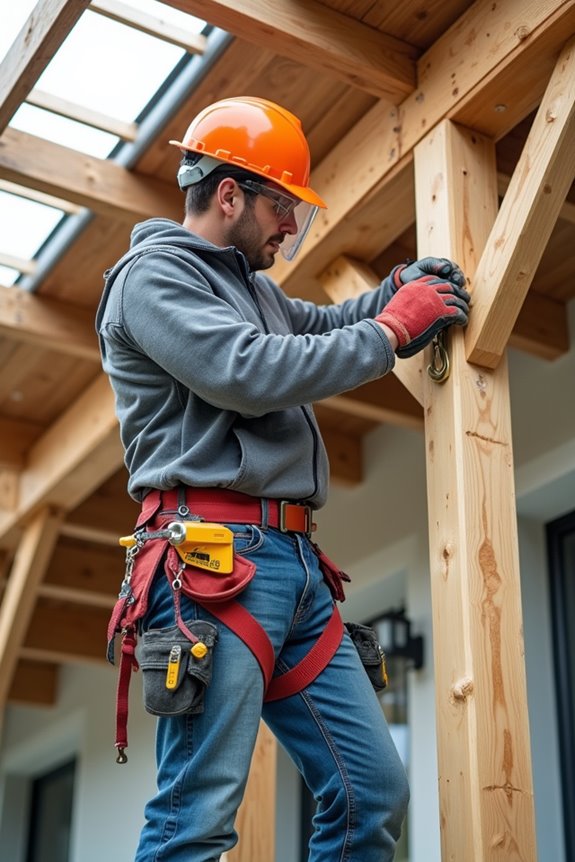
Before you pick up a single tool, you’ll need the right protective equipment. Wear a hard hat, gloves, safety glasses, and steel-toe boots every single day on the job. These aren’t suggestions—they’re your defense against injuries.
Use proper scaffolding instead of balancing precariously on ladders. Scaffolding keeps you stable and secure during post installation and overhead work. Get a helper when working at heights or handling heavy lumber. Two people catch mistakes one person misses.
Follow “measure twice, cut once” to reduce errors and wasted materials. This simple practice saves frustration and money. Before loading your finished pergola, ensure laminated posts are set in concrete and cured for 24 hours minimum. Rush this step, and your entire structure suffers.
These practices aren’t just rules. They’re how experienced builders protect themselves and create quality work.
Annual Inspection, Re-sealing, and Drainage Maintenance
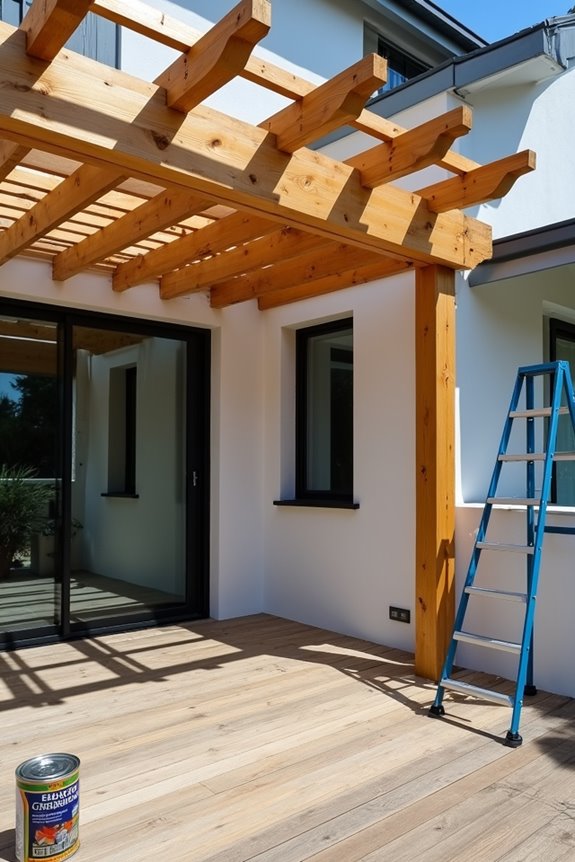
Your pergola’s longevity depends on regular upkeep after installation. You’ll protect your investment by scheduling yearly maintenance tasks that keep everything secure and dry.
Maintenance checklist:
- Schedule annual professional inspections to verify structural integrity and fastening hardware
- Re-apply penetrating exterior sealant every 1–3 years depending on climate exposure
- Seal all end grains and caulk top joints before installation
- Clear gutters and downspouts regularly to prevent drainage issues
- Check ledger board attachments yearly and tighten lag bolts as needed
Your ledger board attachment requires special attention since it connects your pergola directly to your house. Moisture infiltration around this connection causes serious problems. Inspect fastening hardware each season. Tighten loose bolts immediately. Replace corroded hardware promptly.
Drainage maintenance prevents water damage underneath and around your structure. Keep gutters clean. Direct water away from foundation areas. These simple tasks preserve your pergola’s strength for years ahead.