
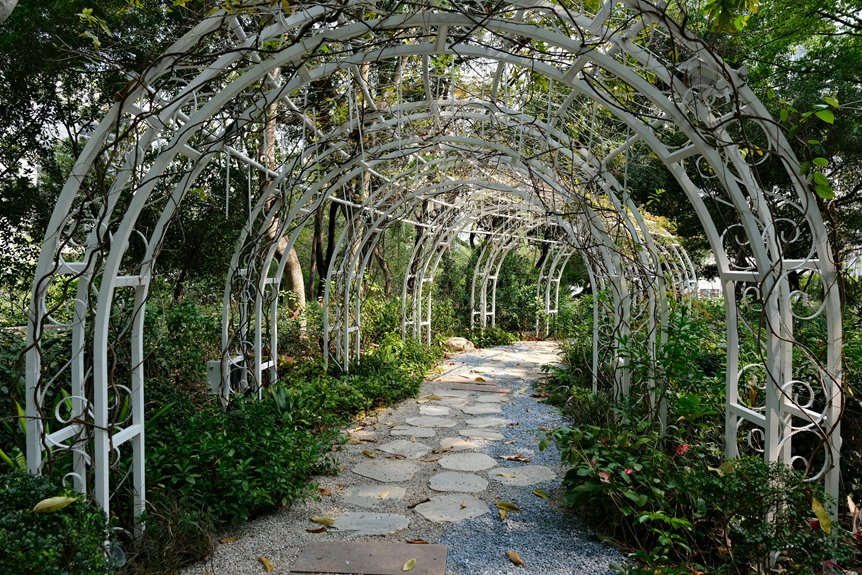
The word “pergola” traces back to Late Latin *pergula*, meaning a projecting eave or shelter. Romans built these structures along walkways for shade and weather protection. They featured open frameworks that supported climbing vines, combining practical function with simple design.
Italian Renaissance designers later refined the concept, using brick, stone, and wood to create more detailed garden structures.
John Evelyn documented this evolution during his 1640s travels, helping introduce the Italian term into English vocabulary by the 1670s. Understanding its architectural journey reveals important details about how gardens evolved.
What ‘Pergula’ Actually Meant to the Romans
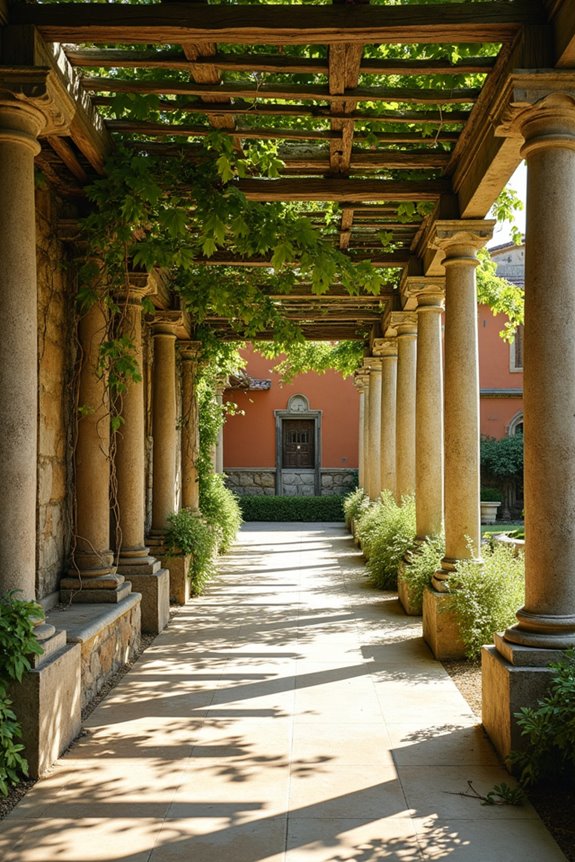
When you trace the word pergola back through history, you’ll find it didn’t start as the garden structure we recognize today. The Romans used pergula differently than we do. It meant a projecting eave or shelter. Think of it as a roof-supported framework. Romans built these structures along walkways. They wanted shade and protection from weather. The projecting eave extended outward. This created a shaded walkway underneath. Vines grew across the open framework. The structure combined function with practicality. Romans borrowed this concept from Greeks and Italians. They refined it over time. The pergula became essential to Roman gardens. You’ll notice the Romans valued outdoor spaces. They understood how architecture shapes experience. This foundation shaped everything that followed. Understanding pergula helps you grasp modern pergolas completely.
Italian Renaissance Gardens and the English ‘Pergola’
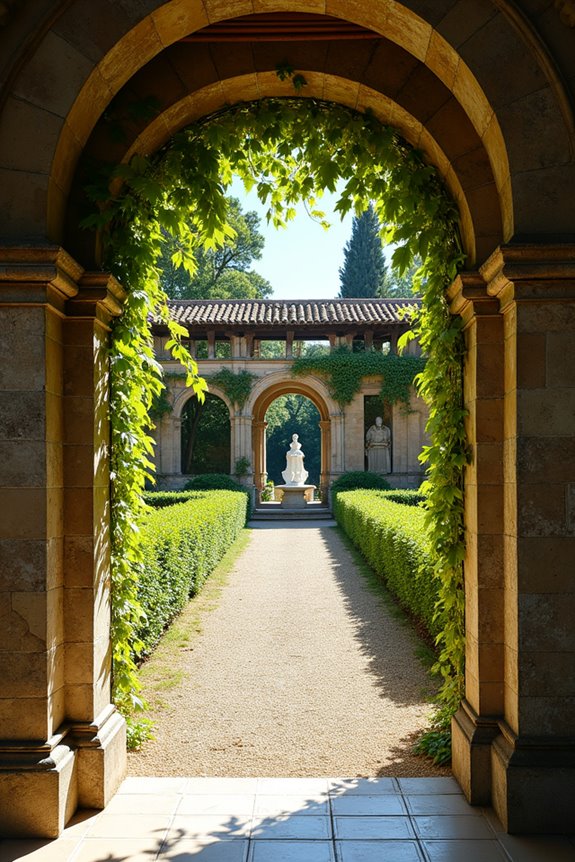
How’d the Romans’ practical pergula transform into the garden feature you see today?
The pergola evolved from Rome’s practical eave into an architectural garden element through Italian Renaissance innovation and English cultural adoption.
Italian Renaissance gardens changed everything. Builders constructed pergolas from brick, stone, or wood. These structures created vine-covered walkways and shaded corridors throughout gardens. The design combined function with aesthetics.
John Evelyn documented this shift. In 1645, he referenced a pergola at Trinità dei Monti in Rome. This observation showed English gardeners were noticing Italian design innovations. By 1654, Evelyn mentioned a pergola near Salisbury, England. This reference signals the term’s adoption into English vocabulary.
You’re witnessing cultural exchange. Italian craftsmen demonstrated how to transform outdoor spaces. The pergola evolved from a simple Roman eave concept into an architectural garden element. English enthusiasts borrowed both the structure and its Italian name. This transition shaped how gardens developed in England.
Medieval Structures That Inspired the Modern Pergola
What garden structures existed before Italians perfected the pergola? You’d find green tunnels made from flexible branches like willow or hazel. These early canopy structures offered shade and protection. Medieval gardeners used latticework to create covered walkways through their gardens. They trained climbing plants over wooden frameworks. These medieval structures weren’t ornate, but they served their purpose effectively.
The design was practical and functional. Gardeners needed shade during hot summers. They also wanted outdoor spaces with visual interest. Medieval latticework provided both solutions. The structures featured open roofs and vertical supports, allowing air circulation while blocking sun.
These ancient pergola-like designs shaped everything that came after. Italian Renaissance gardeners refined the concept further. They saw the potential in these humble medieval structures. You can trace modern pergolas directly back to these medieval innovations.
The Earliest Pergolas: What Romans Really Built
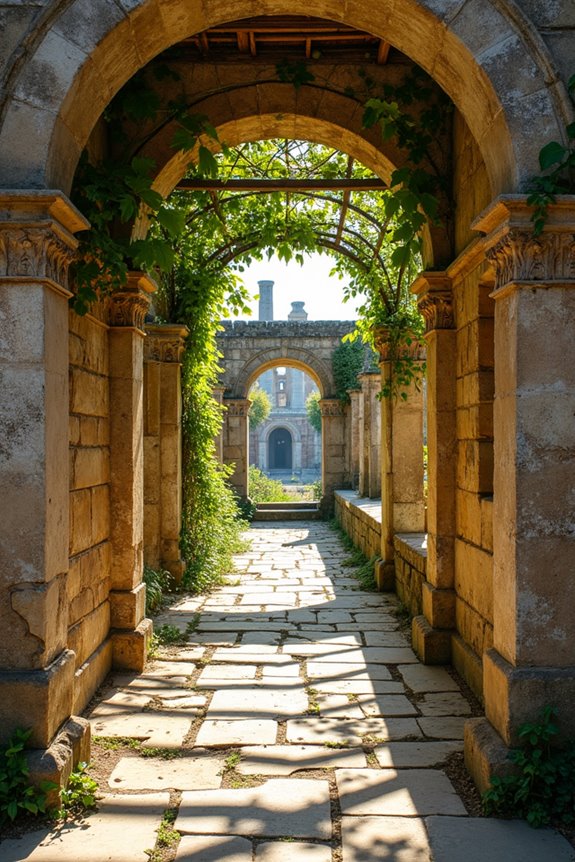
The Romans didn’t actually invent the pergola. You might assume they did, but the structures they built served different purposes. Romans created covered walkways and projecting roofs. They weren’t focused on vine-arbor designs like later periods were.
The Latin word pergula meant a projecting eave or shelter. Romans used these structures for shade and protection from weather. They built them along buildings and pathways.
Renaissance gardens transformed this concept entirely. Italian designers rediscovered Roman architecture and reimagined it. They combined Roman shelter ideas with ornamental vine training. This fusion created the pergola you’d recognize today.
Ancient Egypt’s Shade Structures and Their Design
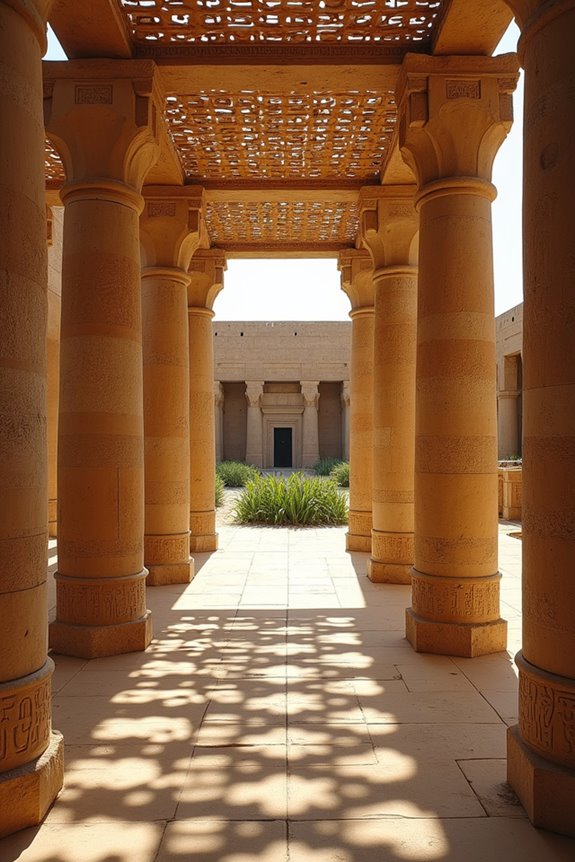
When you picture ancient Egyptian gardens around 1400 BC, you’re seeing some of history’s first pergola-like structures. Egyptians built these shade shelters using sandstone and wood materials, combining practical cooling with spaces where they could gather socially and conduct business. These early designs reveal that you weren’t just getting protection from the sun—you were experiencing a status symbol that showed wealth, garden sophistication, and access to cultivated outdoor leisure.
Egyptian Pergola Origins
How’d ancient Egyptians keep cool in scorching heat? They built clever shade structures. Around 1400 BC, Egyptian officials enjoyed pergola-like designs in their gardens and courtyards. These structures combined sandstone and wood materials. They created elevated walkways and shaded seating areas. Purpose? Beating the heat and showing off status.
You’ll notice these early Egyptian designs influenced later Roman and Mediterranean gardens. They shaped how pergolas evolved in Europe. The word “pergola” itself comes from Latin (pergula). However, the specific Egyptian design adaptations aren’t from a direct Egyptian word. Instead, historians infer them from ancient garden practices and archaeological evidence.
These practical structures served both comfort and prestige. High officials relaxed beneath them. Garden spaces became social hubs. Egyptian innovations established foundational pergola architecture that spread worldwide.
Materials And Construction Methods
Ancient Egyptians didn’t just dream up pergolas. They engineered them with purpose. You’ll find their construction materials were straightforward. Sandstone and wood formed the primary framework. These materials provided durability and practical shade for high-ranking officials.
The pergola etymology traces back to Late Latin pergula, meaning projecting eave. Understanding this linguistic journey helps you appreciate architectural history’s depth. Egyptian builders created these structures as functional social spaces, not mere decorative elements.
Their construction methods were sophisticated. Workers arranged sandstone blocks and wooden beams to create sturdy latticed canopies. Vines grew through the open framework, adding natural cooling. This integration of construction materials with living plants represented early architectural innovation.
You’re witnessing the foundation of shade structure design.
Status And Social Function
Why’d Egyptian elites cherish these shaded structures so much? These weren’t just nice-to-haves. They were status symbols. High-ranking officials gathered in ancient gardens under pergola-like structures around 1400 BC. The pergola origin traces directly to this practice of creating exclusive social spaces.
You see, these shade structures served dual purposes. They cooled people down in Egypt’s brutal heat. They also displayed wealth and power. Only important people accessed these pergola-designed areas.
The design itself communicated status. Projecting eaves and open frameworks supported climbing plants. This combination created impressive shaded walkways. Visitors understood immediately: this person held real authority.
Ancient gardens became gathering places. Officials conducted business. They entertained guests. The social function of pergolas shaped how people interacted. These structures weren’t decoration—they were power made visible.
Arbors, Green Tunnels, and Pergolas: What’s the Difference?
You’ve probably noticed garden structures that look similar but aren’t quite the same. Let’s break down the differences.
Arbors are small wooden benches with roofs and lattice sides. Climbing plants grow through them. They work well for intimate garden spots.
Arbors are small wooden benches with roofs and lattice sides, perfect for training climbing plants in intimate garden spaces.
Green tunnels came first historically. Gardeners bent willow or hazel branches into arches. These created shaded walkways long before pergolas existed. They influenced how we design garden structures today.
Pergolas are larger and more open. They feature vertical posts, crossbeams, and open lattice patterns. You can train vines across them easily. They expand your outdoor living space substantially.
Understanding these differences helps you select the right structure. Each one serves a specific purpose in your garden design.
The 1670s: When ‘Pergola’ Entered English Vocabulary
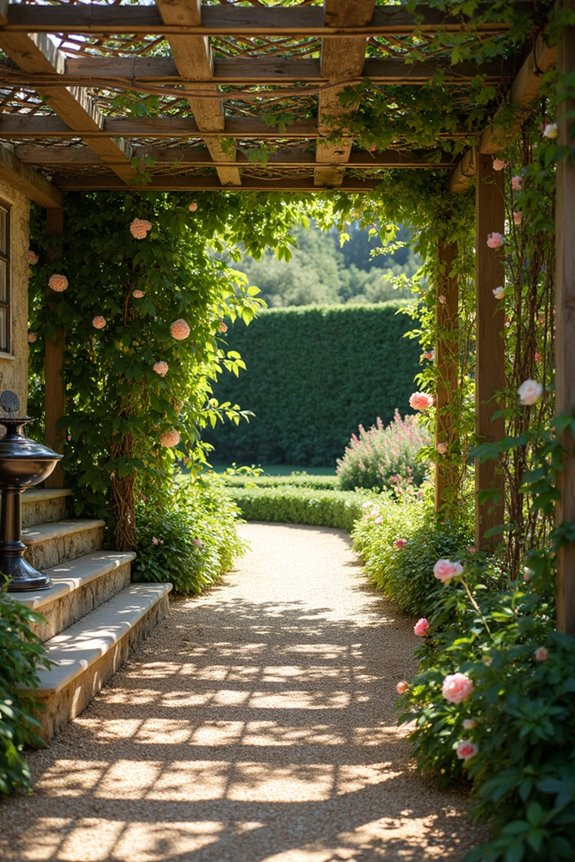
The journey of the word “pergola” into English documents cultural exchange. During the 1670s, “pergola” appeared in English texts with increasing regularity. This timing reflected Italian influence on English vocabulary as gardens became fashionable among wealthy landowners.
The etymology reveals how Late Latin pergula (meaning projecting eave) traveled through Italian design traditions into English usage. John Evelyn’s writings from 1645–1654 document early references to pergola structures supporting vines. Yet the formal adoption happened later.
Language evolved as garden enthusiasts embraced the Italian term because it precisely described these distinctive structures. The word persisted because it filled a linguistic gap. English lacked a precise term for vine-covered frameworks. By the 1670s, pergola had become established vocabulary. This demonstrates how specialized architecture introduces new words into everyday language.
John Evelyn’s Garden Observations and the English Pergola
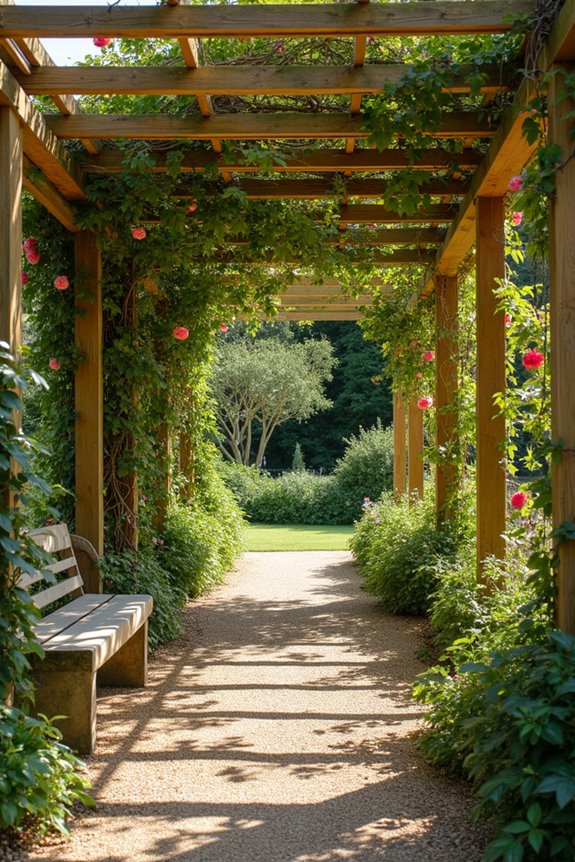
You’re looking at a turning point. John Evelyn, an English diarist and garden enthusiast, encountered Italian pergolas firsthand during his travels in the 1640s. His detailed observations—particularly his 1645 documentation of a pergola at Trinità dei Monti in Rome and his later 1654 reference to a pergola near Salisbury—transplanted this Italian garden concept directly into English vocabulary and landscape design.
Evelyn’s Italian Garden Encounters
During his travels through Italy in 1645, John Evelyn encountered architectural garden features that would later shape English landscape design. He documented these Italian gardens with systematic attention. At Trinità dei Monti in Rome, Evelyn observed pergolas firsthand. These structures impressed him. They combined practicality with elegance. The pergola, he noted, provided shade through vine-covered lattice work. This Italian garden element captured his focus.
Evelyn recognized the significance of this structure. The pergola represented more than decoration. It addressed specific functional requirements in outdoor spaces. English gardeners would adopt this innovation for practical reasons. The term itself carried Italian prestige and sophistication. His observations documented how Continental design could enhance English estates. Evelyn’s detailed notes preserved this moment when English gardening vocabulary expanded to include pergola.
English Adoption And Documentation
How did English gardeners come to adopt the Italian word pergola? John Evelyn’s travels proved decisive. In 1645, he observed a pergola at Trinità dei Monti in Rome. This encounter introduced him to the Italian term and design. Later, in 1654, Evelyn referenced a pergola near Salisbury, bringing the word into English garden vocabulary. His documented observations created a bridge between Italian Renaissance gardens and English practice.
English adoption accelerated through written documentation. Dictionary entries and garden discussions reinforced pergola’s meaning. The word shifted from its Late Latin root—pergula, meaning projecting eave—into broader English usage. Early English gardeners linked pergolas to lattice structures and arbors. This integration transformed pergola from a purely Italian architectural element into an established English garden feature. Documentation solidified the term’s place in English language and practice.
How ‘Pergola’ Traveled From Italian to English
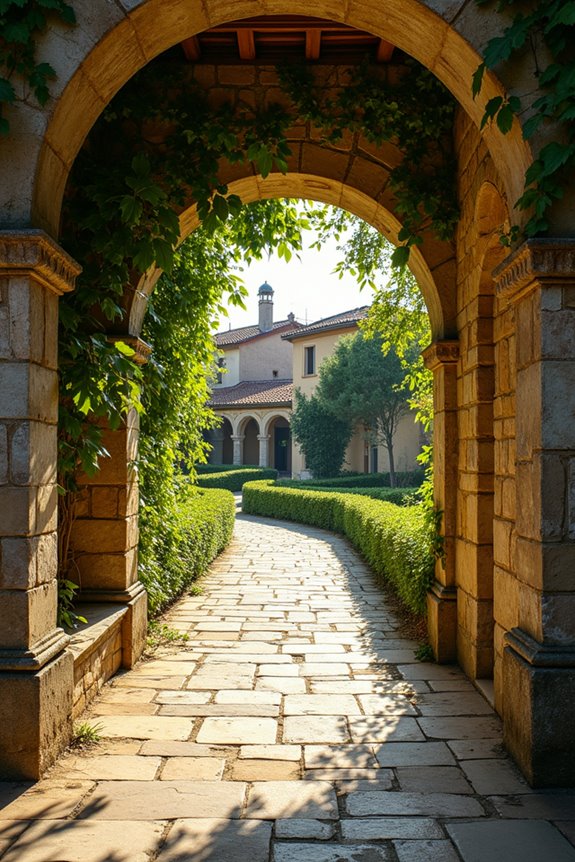
When did English speakers first embrace the word “pergola”? You can thank Italian gardens for introducing this term to English. The word traveled from Latin pergula through Italian pergola into English usage. English borrowed the Italian term directly. Italian gardeners had already perfected vine-covered structures. These structures became popular throughout Renaissance Italy. English travelers and scholars encountered them firsthand. John Evelyn documented Italian pergolas in 1645 at Trinità dei Monti. He later referenced similar structures near Salisbury in 1654. His writings helped legitimize the word in English. The term didn’t just describe a physical structure. It represented an entire garden philosophy. You were adopting both vocabulary and aesthetic values simultaneously. This linguistic journey shows how language follows cultural exchange.
Green Tunnels: The Forgotten Ancestor of Pergolas

Something existed in gardens long before the word “pergola” even entered English. Green tunnels—arched passageways made from bound willows or hazels—provided shaded walkways centuries earlier. You’d recognize them as the direct ancestors of modern pergolas.
These structures served real purposes. They offered cooling relief and moderate dryness during hot months. Climbing plants draped across the frames created natural tunnels that influenced later garden design thinking.
| Feature | Green Tunnels | Early Pergolas |
|---|---|---|
| Materials | Willow, hazel | Wood, vines |
| Function | Cooling, shade | Shade, support |
| Era | Medieval | Renaissance |
| Design | Bound arches | Formal structures |
The Medici villa La Petraia exemplified this evolution. You can trace how these forgotten structures shaped Renaissance and Baroque gardens. Understanding green tunnels helps you appreciate pergola development—connecting ancient practical ideas with formalized garden architecture.
The Baroque Era and Why Terminology Standardized
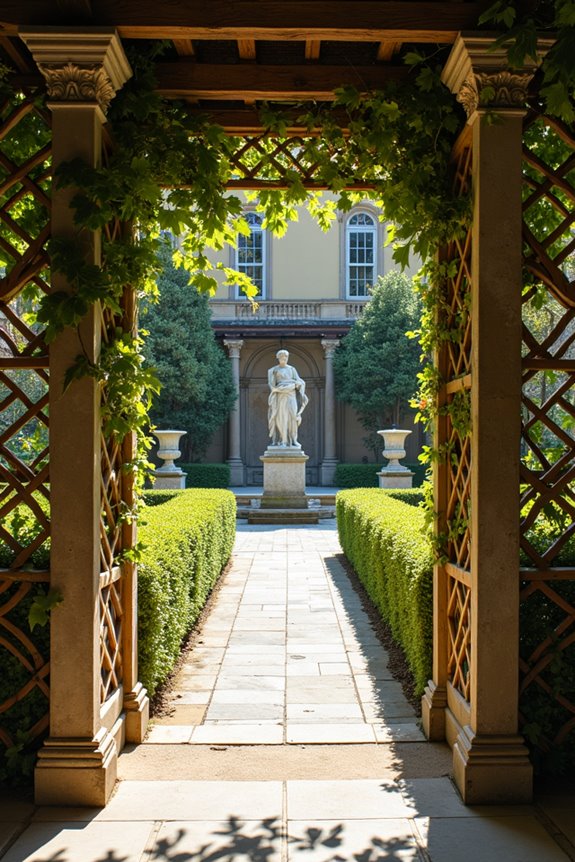
Why’d the word “pergola” suddenly stick around in the 1600s and 1700s? The Baroque era brought order to garden design. Designers needed shared language. They borrowed “pergola” from Italian usage and traced it back to Late Latin pergula, meaning a projecting eave. This terminology standardization happened because gardens became more formal and complex. Baroque creators integrated pergolas with ornamental features and climbing plants deliberately. They weren’t randomly thrown together anymore. Green tunnels and Renaissance arbours evolved into structured pergolas. The pergola origin connects directly to this period’s architectural vocabulary. Roofed, sheltered garden passages required specific names. You can see how standardization served practical purposes—architects and gardeners could communicate clearly about designs. This shared terminology became the foundation for modern garden structure language.
How Renaissance Designers Built and Refined Pergolas
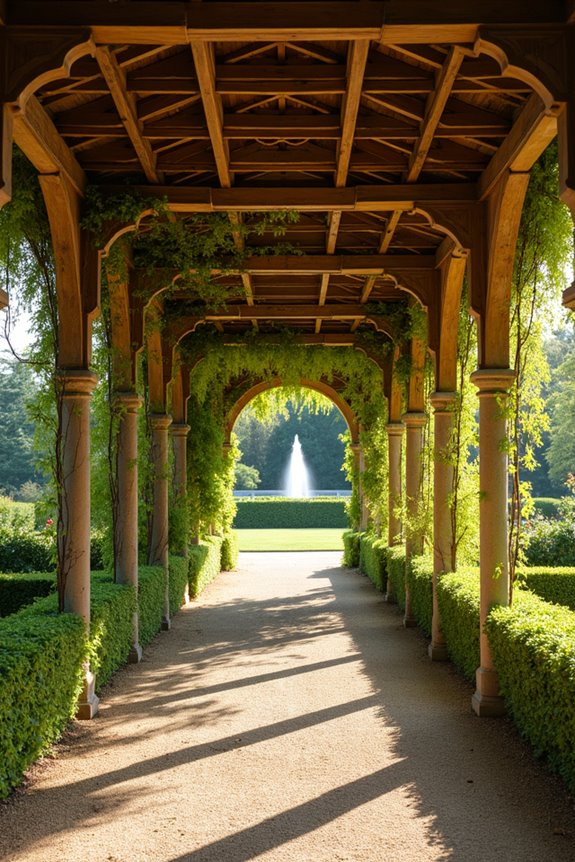
Renaissance designers didn’t just dream up pergolas overnight. They borrowed Italian garden traditions and refined them using brick, stone, and wood structures that you can still see today at places like Rome’s Trinità dei Monti. You’ll notice they figured out that ledger boards and cross rafters weren’t just decorative—they actually held up the vines while creating shaded outdoor spaces that people actually wanted to spend time in.
Italian Renaissance Design Innovations
How’d Italian architects and garden designers transform simple garden structures into the elegant pergolas we recognize today? They innovated pergola design during the Italian Renaissance by combining function with beauty. Designers used brick, stone, and wood to build sturdy frameworks that supported climbing vines. These materials created lasting structures, not flimsy temporary ones.
Ledger boards and projecting eaves became signature architectural elements. They anchored the pergolas while adding ornamental appeal. Vines grew across these frameworks, providing vineyard shade in outdoor spaces.
The Trinità dei Monti in Rome showcased this aesthetic brilliance. Vine-covered corridors transformed gardens into sophisticated retreats. Renaissance estates featured increasingly elaborate pergolas, moving beyond simple walkways.
These innovations established pergolas as cultivated outdoor living spaces. Their design principles influenced English and continental gardens for centuries afterward.
Materials And Construction Techniques
The elegant pergolas of Renaissance gardens didn’t appear by accident—they were built with intention and skill. Renaissance designers refined construction techniques by selecting brick, stone, and wood as primary materials. These sturdy components could support climbing plants like vines and ivy. Wrought iron and timber became increasingly popular in later periods. These materials allowed builders to create heavier structures with ornate detailing. The pergola construction process involved careful planning. Designers projected beams outward from walls or posts. They spaced these beams to balance shade and sunlight. Climbing plants then filled gaps between structural elements. This combination—solid materials plus strategic spacing—created comfortable outdoor walkways. Each material choice served a dual purpose: strength and aesthetic value. This methodical approach established pergolas as essential garden features throughout Europe.
Materials and Methods in Historic Pergola Construction
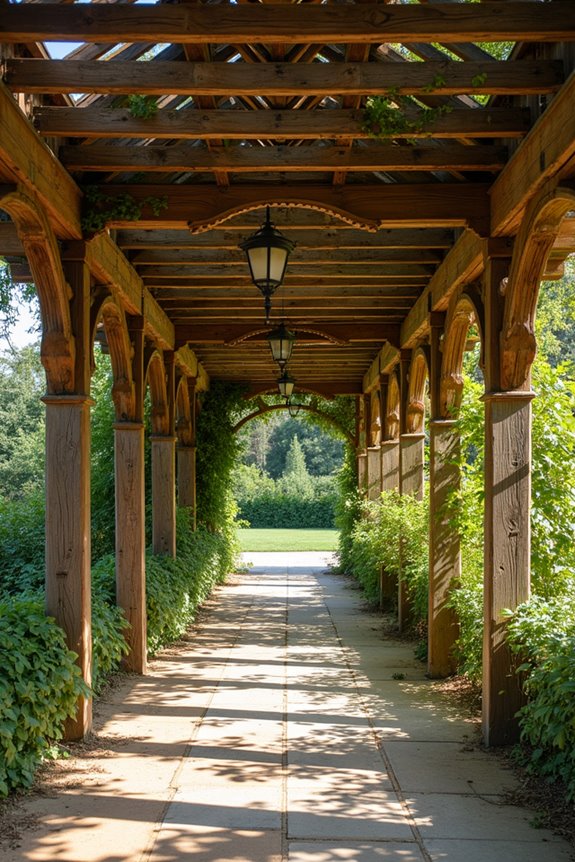
As gardeners and builders adapted the pergola concept across Europe, they developed distinctive approaches to materials and construction that reflected both local resources and practical needs. Historic pergola construction relied on what nature and each region offered. Wood dominated early designs. Stone appeared in Mediterranean regions. Materials varied significantly by location and availability.
| Region | Primary Material | Secondary Material | Timeline | Purpose |
|---|---|---|---|---|
| Italy | Chestnut wood | Stone pillars | 1600s | Vine support |
| England | Oak timber | Brick bases | 1650s | Shaded passage |
| France | Ash wood | Iron brackets | 1700s | Garden feature |
| Spain | Pine beams | Limestone posts | 1600s | Cooling |
| Northern Europe | Softwood | Plaster | 1800s | Ornamental |
Vine-supported walkways required sturdy frameworks. Hand-carved details showcased craftsmanship. Mortise and tenon joints held structures together securely. These historic materials and techniques created lasting construction that remains visible today.
Where to See Historic Pergolas: Renaissance Gardens Today
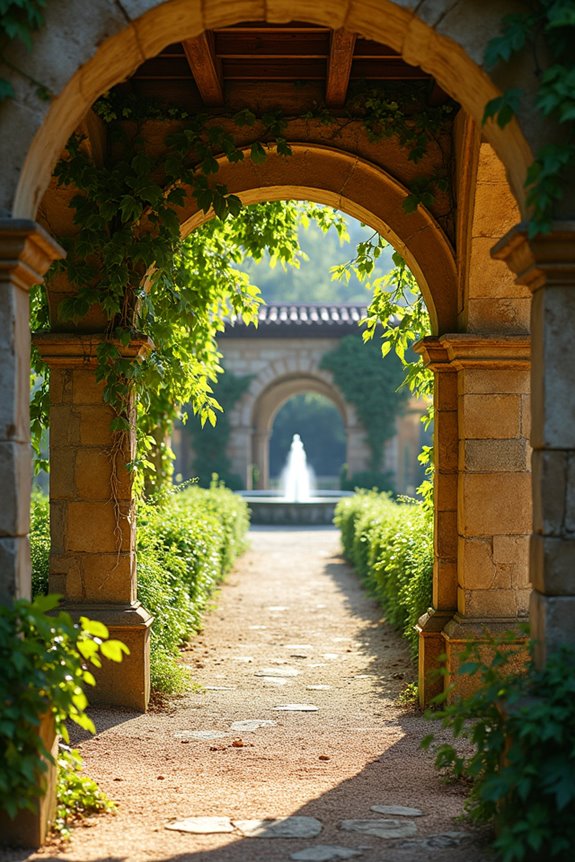
Once you’ve understood how craftsmen built these structures with local materials and skilled joinery, you’ll want to see them in person. The Trinità dei Monti in Rome showcases one of Europe’s earliest documented pergolas from around 1645. You’ll find yourself walking beneath latticed wooden frameworks that support climbing vines. This garden demonstrates pergola origins effectively. Renaissance gardens across Italy and England preserve these architectural examples. Visit English estates designed by Lutyens and Jekyll. They incorporated pergolas into their landscape plans. You’ll experience how these structures create shaded walkways and sitting areas. The open lattice design filters sunlight effectively. Walking through Renaissance gardens today connects you to centuries of horticultural tradition. You’re literally following paths that garden enthusiasts have valued since the 1600s.