

Your deed controls the boundary. Not the fence. Check your deed’s legal description first—it’ll use measurements and landmarks to define where your property actually ends. Order a certified survey from a licensed surveyor to confirm the exact line. Compare that survey to your deed and any existing monuments (metal pins or concrete markers). If the fence crosses your boundary, it’s encroachment. Document everything with photos and measurements. Mediation works before court. A boundary agreement recorded with the county settles disputes officially. Understanding these steps positions you to explore lasting solutions.
Is This Fence Yours? Start by Checking Your Deed

Where’s the actual property line? Your deed holds the answer. This legal document contains a survey or metes-and-bounds description. That description defines your true boundary line. Don’t assume the fence marks it.
Your deed holds the answer to your property line. Don’t assume the fence marks it—check your survey or metes-and-bounds description instead.
Compare your deed’s description with any existing survey. Look for measurements, landmarks, and directions listed on both documents. They might not match. Physical features like trees or ditches shift over time. Your deed’s legal description doesn’t.
Check whether your deed mentions the fence specifically. Some deeds note fence ownership or maintenance responsibilities. Others stay silent on fencing details.
If descriptions conflict, that’s a red flag. Uncertainty now prevents costly disputes later. Consider getting a certified survey done. It confirms the actual boundary line officially. You’ll know exactly where your property ends and your neighbor’s begins. This clarity protects both of you.
Check Your Deed for Boundary Description
Your deed contains the legal description of your property, and that’s your starting point. This description uses either metes and bounds (a system describing distances and directions from a starting point) or references to a recorded survey, and it will tell you exactly where your boundary line should be. The written deed language controls the actual boundary, not the fence that’s currently standing—so you need to read it carefully to see what you actually own.
Deed Language and Boundaries
The deed to your property is the legal document that defines where your property line sits. Your deed language contains either a metes-and-bounds description or a reference to a surveyed plat. These legal descriptions establish your boundary—not the fence’s location.
Metes-and-bounds descriptions use measurements and directions. Plat references point to official survey maps. Both methods create precise boundary lines independent of physical fences.
A fence placement doesn’t change your deed’s boundary line. Your actual property line remains where the deed says it does. If a fence doesn’t align with your survey boundary, you’ve identified the issue.
Review your deed carefully. Identify which description type you have. This step clarifies your legal boundaries before addressing any physical fence disputes.
Legal Description Review
How do you know where your property actually ends? Start by carefully reading your deed. Look for the legal description section, which typically appears near the document’s end. This section contains specific measurements and references like metes and bounds or section/township/range coordinates.
Next, obtain a boundary survey if one exists. Compare your deed description with this survey document. Do the measurements match? Do the referenced monuments or markers align? Discrepancies here require immediate attention.
Document everything you find. Note coordinate numbers, distance measurements, and landmark references. If your deed references a surveyed plat, get that document too. This deed comparison process reveals whether your fence sits on the actual legal boundary or somewhere else entirely. Inconsistencies between written descriptions and physical markers often spark disputes you’ll want resolved quickly.
Order a Professional Survey to Confirm Boundaries
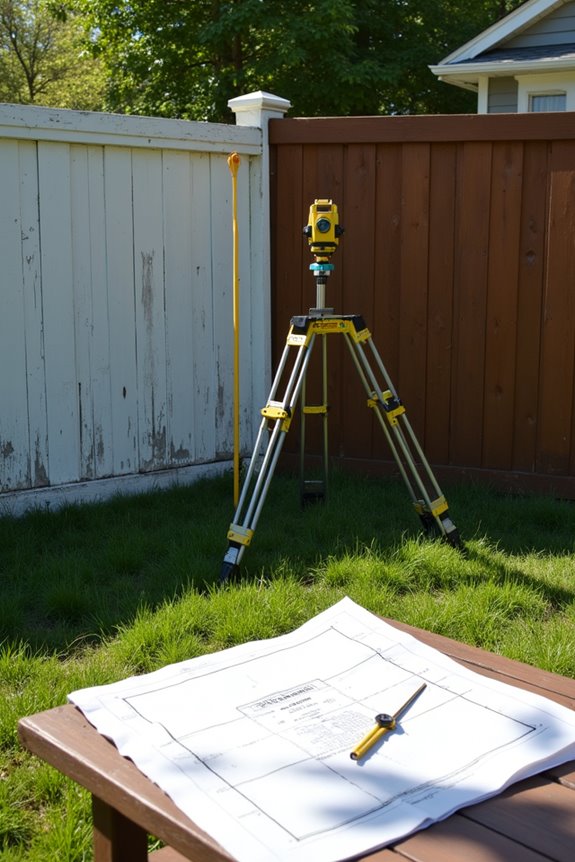
You’ll need a professional survey. A licensed surveyor examines your deed, compares it with the actual land, and creates official documentation that courts and mediators accept as evidence. This certified map and report settle the dispute by confirming which fence actually sits on your legal boundary line.
Survey Confirms Legal Boundaries
When do you really know where your property line sits? A professional survey gives you that answer. The surveyor measures and marks your actual boundary line. This clarifies any confusion between your deed description and where fences currently stand.
You’ll receive certified documentation showing the exact fence dispute resolution. The survey compares legal descriptions with physical markers on the ground. This confirms whether your fence sits on the boundary. It might reveal the fence actually belongs to your neighbor. Or it could prove you’re responsible for maintenance and repairs.
With this survey in hand, you’ve got solid proof. Your deed records now align with the surveyed boundary line. You can settle ownership questions once and for all. No more guessing. Just clear, legal answers about what’s yours.
Documentation Provides Admissible Evidence
Most boundary disputes won’t disappear without solid proof. You need documentation that courts will actually accept. A professional survey provides the strongest boundary evidence available. It creates an official record showing exact property lines. This documentation becomes admissible in legal proceedings. You should gather existing surveys first to identify established boundaries. Look for any gaps between deed descriptions and current fence positions. When discrepancies exist, you’ll need a new certified survey. The surveyor produces a formal report with clear metes and bounds. This technical document maps your true boundary precisely. You can then use this survey to support agreements or legal actions. Documentation of prior boundary agreements, when aligned with survey results, strengthens your position significantly. Together, they form compelling evidence that influences resolutions without requiring costly litigation.
Check for Existing Surveys and Monuments
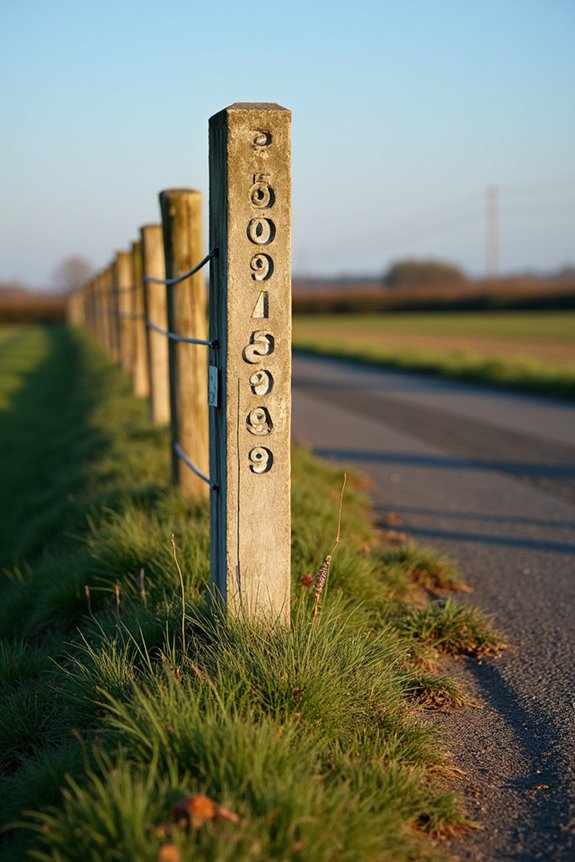
Where’s the proof? Physical evidence on your property tells the real story. You’ll find recorded monuments or pins marking the true delimitation line. These markers include iron pins, concrete monuments, or visible survey markers. Here’s what you should do:
Physical evidence on your property tells the real story: recorded monuments, iron pins, concrete markers, and survey pins establish true property lines.
- Search for original survey documents and legal descriptions in county records
- Locate physical markers on your property that establish the actual delimitation
- Review plat maps to see how property lines relate to existing fences
- Note differences between older delimitation markings and modern GPS-based surveys
Modern surveys shift perceived boundaries using updated technology. If you’ve discovered multiple surveys, consider hiring a licensed surveyor for a current certified survey. This professional documentation becomes admissible evidence in disputes. The surveyor’s findings carry legal weight that’ll settle disagreements decisively.
Fence Codes and HOA Rules
Have you checked your local fence regulations yet? Your municipality likely requires building permits for fence installation. These permits exist to protect property line integrity and prevent costly disputes.
HOA rules matter too. If you live in a community with an HOA, review your CC&Rs or architectural guidelines carefully. These documents specify fence height, materials, color, and placement standards. Violating HOA rules invites enforcement actions, including fines or mandatory removal.
Your fence boundary location determines ownership responsibilities. Fences straddling the property line typically require shared maintenance between neighbors. Permits and surveys clarify exactly where your fence sits relative to the property line.
Contact your local building department and HOA office. Request copies of permit records and enforcement policies. This documentation prevents misunderstandings about your fence obligations and rights.
Does Your Neighbor’s Fence Cross the Boundary?

When’s the actual property line versus where a fence physically sits? That’s the key question. Here’s what you need to know:
- The surveyed boundary line determines fence location, not post placement
- A fence crossing the boundary may constitute encroachment regardless of appearance
- Updated surveys provide the most persuasive evidence of true boundaries
- Long-standing fences can trigger prescriptive rights that complicate ownership
Your neighbor’s fence might look fine on their side. But if it crosses your surveyed boundary line, it’s encroaching. Posts sitting on their property don’t matter if the fence itself crosses over. This distinction trips up many property owners.
Getting a new survey costs money. It’s often worth it though. That document becomes your strongest proof in disputes. Without it, you’re essentially guessing where your property actually ends.
Document the Fence Location With Photos and Measurements
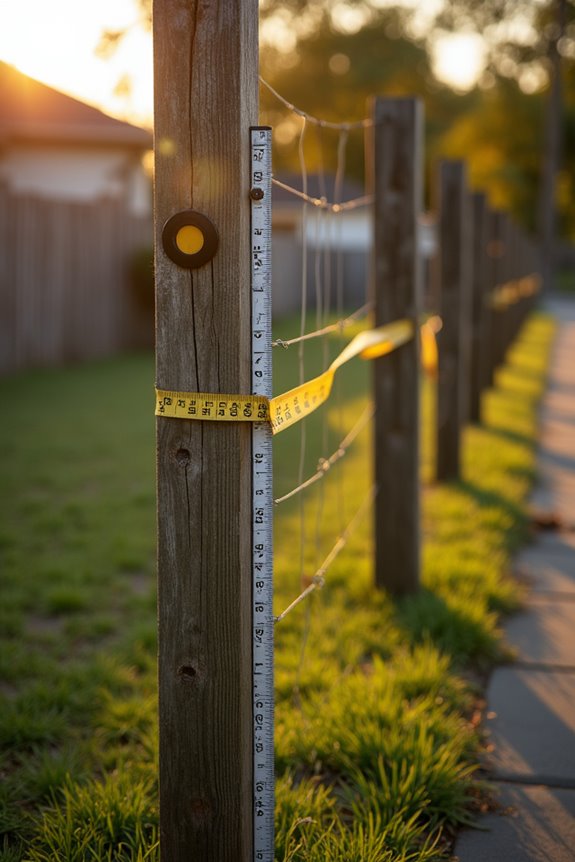
Before you’ll need solid evidence of where it actually sits, you can prove a fence encroaches on your property. Start by taking photographs from multiple angles. Label each photo with the date, exact location, and nearby landmarks. These images create a visual record you’ll reference later.
Next, take precise measurements from your property’s boundary lines. Compare the fence’s actual position against your deed or survey. Note which posts sit on which side of the boundary. This documentation reveals encroachments clearly.
Create a dated, labeled map or sketch. Show the fence alignment relative to your property lines. Include any shared components suggesting joint ownership.
This evidence strengthens your position during negotiations. You’re building a solid foundation for resolving disputes fairly and legally.
Verify Utility Easements and Underground Lines
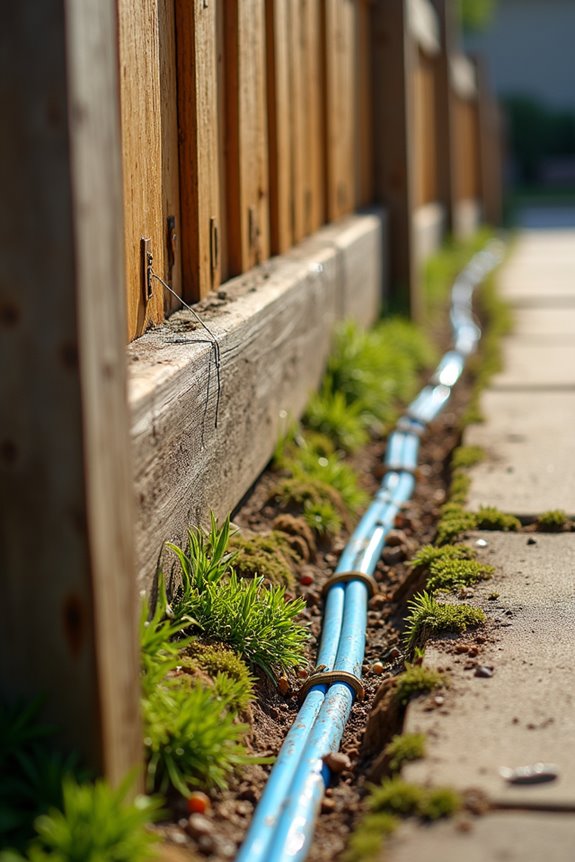
Now that you’ve documented the fence’s physical location, you’ll need to check what’s underneath and around it. Utility easements can complicate ownership questions.
Steps to follow:
- Review your deed, plat, and title commitment for recorded easements
- Contact water, gas, electric, sewer, and telecom providers to locate underground lines
- Request a current boundary survey showing precise property lines and any offsets
- Obtain written confirmation from utilities or a surveyor for your final fence location
Underground lines often sit offset from your actual boundary. Utilities need access corridors to maintain services. A licensed surveyor can pinpoint everything accurately. Written confirmation prevents costly mistakes later. You’ll avoid service interruptions and future disputes by handling this step thoroughly before any fence work begins.
Texas Law on Fence Ownership and Boundaries
Clarity on fence ownership hinges on recorded documents. In Texas, deeds and certified surveys—not physical fences—legally define your boundary. A fence sitting on your property line might be jointly owned. You’ll need to check your deed and compare it against a current survey to verify the exact boundary location.
Long-term fence use creates gray areas. Even if you’ve maintained a fence for years, that doesn’t automatically make it yours. Written agreements matter most. If you and your neighbor want to formalize ownership, document everything in a boundary agreement. Then record it with your county recorder.
Getting a professional survey removes guesswork. This certified document shows precisely where your property ends. It’s your strongest tool for resolving ownership questions fairly and legally.
Have an Open Conversation With Your Neighbor
Once you’ve identified your property line through deeds and surveys, you’re ready for the next step. Start with a friendly conversation about fence ownership before tensions escalate. You’ll want to approach this thoughtfully and calmly.
Start with a friendly conversation about fence ownership before tensions escalate—approach this thoughtfully and calmly.
How to handle your boundary conversation:
- Choose a relaxed time and place where you won’t feel rushed or defensive
- Bring factual documents like deeds, surveys, and fence location records to reference
- Listen to your neighbor’s perspective without interrupting or becoming confrontational
- Discuss solutions together, such as commissioning a new survey or adjusting the fence
This collaborative approach builds trust. You’re working toward shared understanding, not winning an argument. Document everything you discuss in writing afterward. Include agreed timelines and next steps. Clear communication prevents future misunderstandings about your boundary and fence ownership responsibilities.
Use Mediation to Avoid Court

What happens when your neighbor won’t budge on the fence line? Mediation offers a practical escape route. You’ll work with a neutral third party who helps both of you find common ground without stepping into a courtroom.
Here’s what makes mediation valuable. It preserves your relationship by focusing on solutions instead of blame. You might split costs equally. You might adjust the boundary line together. A mediator can help you draft a binding boundary agreement or quitclaim deed. Once recorded, this document protects future owners too.
Timing matters. Schedule mediation after direct talks stall but before litigation begins. This approach costs less than court battles. If mediation fails, you still retain your right to pursue legal action. You’ve simply chosen dialogue first.
Create a Boundary Agreement
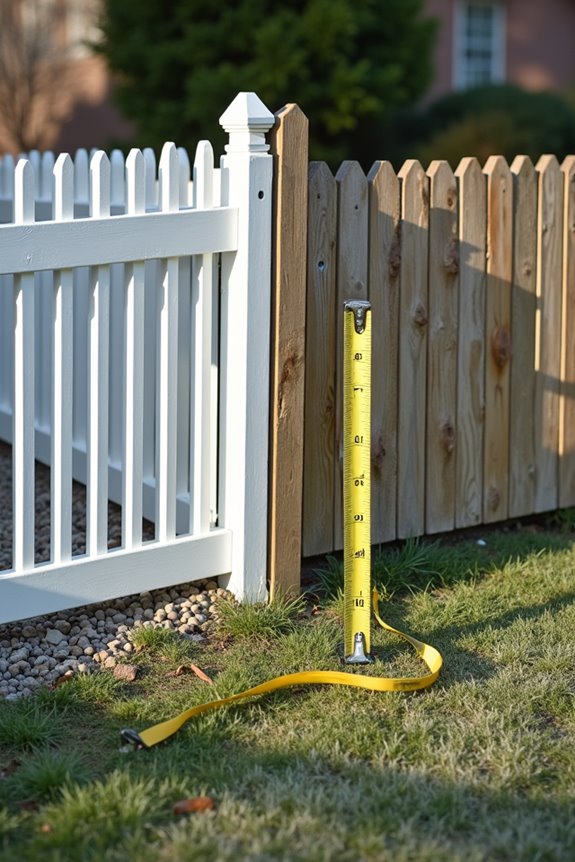
How do you lock in a fence decision that’ll stick?
A written boundary agreement transforms your mediation success into permanent protection. This document becomes your neighborhood’s official rulebook. Here’s what you need:
- Reference a certified survey that pinpoints your exact boundary line and property edges
- Specify fence maintenance duties including who pays for repairs, replacements, and upkeep schedules
- Detail boundary line definitions using deed descriptions or survey markers for absolute clarity
- Include notice requirements so neighbors communicate before making changes or repairs
Once you’ve drafted everything, sign the agreement and record it with your county recorder. Recording makes it legally binding for all future owners. This step prevents old disputes from resurfacing. Your investment now—time spent documenting details—pays dividends for decades ahead.
Know When to File a Quiet Title Action
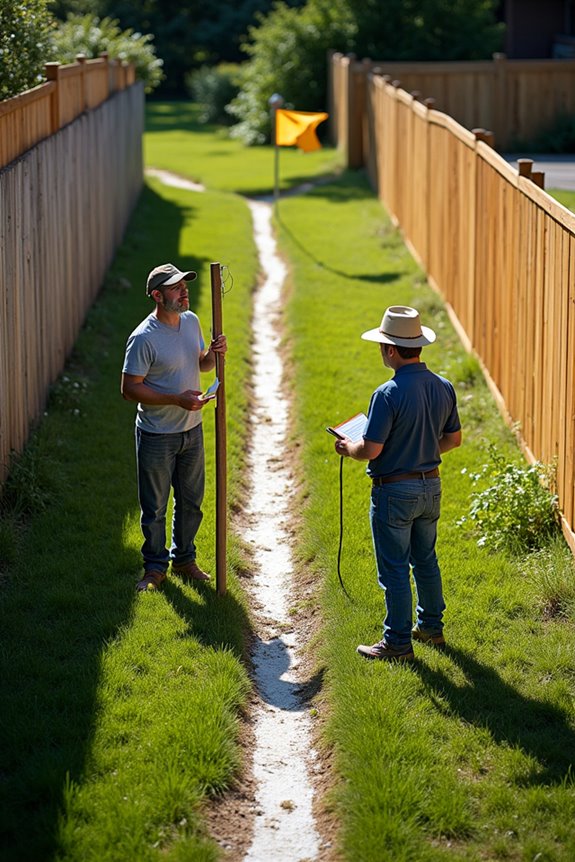
If negotiation and surveys haven’t resolved your fence dispute, a quiet title action might be necessary. You’ll file this formal lawsuit when you need the court to officially decide who owns the land and order any encroaching fences removed. Understanding when and how to file one helps you prepare for what is often a more expensive and lengthy process than earlier settlement attempts.
When Quiet Title Applies
You’ve tried talking it out. Negotiations failed. Mediation didn’t work. Now you’re wondering if a quiet title action is right for you.
Quiet title applies when you need court help settling boundary disputes. Consider filing when:
- Other remedies have failed to resolve ownership questions
- You possess clear evidence like deeds, surveys, and boundary use history
- Competing claims threaten your property rights or create encroachment risks
- You want a court order officially declaring true ownership
A quiet title action removes competing claims permanently. It prevents future encroachments and establishes legal certainty about your fence line.
You’ll need certified boundary surveys. Gather deed descriptions and records showing exclusive ownership. Document any prior boundary agreements or neighbor acquiescence. This evidence strengthens your case significantly.
Filing Requirements And Process
Once you’ve decided a quiet title action fits your situation, the filing process begins. You’ll need to gather critical documents. A professional survey showing your property lines is essential. Deed records with clear legal descriptions support your claim. Documentation of acquiescence—where neighbors accepted the boundary for years—strengthens your case.
Next, file your complaint with the court in your county. You’ll name all parties with competing claims as defendants. Include your survey, deeds, and any written boundary agreements. Courts often order another survey to confirm findings independently.
Timing matters. State statutes of limitations vary. File before deadlines pass. Your real estate attorney handles procedural details and court filings. Once the court issues a decree, record it with your county recorder. This formalizes the boundary officially.
Get Legal Help
When a fence dispute won’t budge through conversation alone, what’s your next move? You’ll want professional help. Here’s what you need:
- Hire a real estate attorney with boundary dispute experience to interpret your deeds and any prior agreements
- Request a formal boundary survey from a licensed surveyor who’ll identify the exact legal boundary line
- Review recorded deeds and historic surveys to see where boundaries actually sit relative to current fences
- Consider mediation first to reach mutual agreement before pursuing court action
Your attorney reviews legal documents while your surveyor provides hard evidence. Together they’ll determine which fence truly belongs to you. This expert combination gives you credibility if you eventually need quiet title action or an injunction. These steps form your foundation for resolving this boundary dispute properly.